By Vũ Duy | Founder, Zonpal | 8+ years Amazon FBA | 80+ international brands
In late 2017, I started selling Vietnamese handicrafts on Amazon US. No course, no mentor, just trial and error.
In the first year, I learned that Amazon is not just a sales channel. It is an ecosystem with its own rules. The sellers who understand those rules win. The ones who do not, struggle, regardless of how good their product is.
After 8+ years in the field and working with 80+ brands across the US, UK, Australia, Canada, and Europe, this guide is not a rehash of what you can find anywhere. It is what we have learned from actually doing it.
Table of Contents
- What is Amazon FBA?
- FBA vs FBM: which one is right for you?
- The 4 most common mistakes we see from new sellers
- How to start selling on Amazon FBA: a 6-step process
- How much capital do you actually need?
- Frequently asked questions
- Where Zonpal can help
What is Amazon FBA?
FBA stands for Fulfillment by Amazon. It means Amazon handles the warehousing, packing, shipping, returns, and customer service on your behalf.
The process works like this:
- You manufacture or source your products and ship them to an Amazon fulfillment center.
- When a customer places an order, Amazon picks, packs, and ships it directly to them.
- Amazon manages all post-sale logistics, including returns and refunds.
Your job is to focus on the product, the brand, the marketing, and the strategy. Amazon handles the rest.
This is why FBA has become the default model for sellers building private label brands on Amazon, rather than managing their own warehousing and last-mile delivery.
FBA vs FBM: which one is right for you?
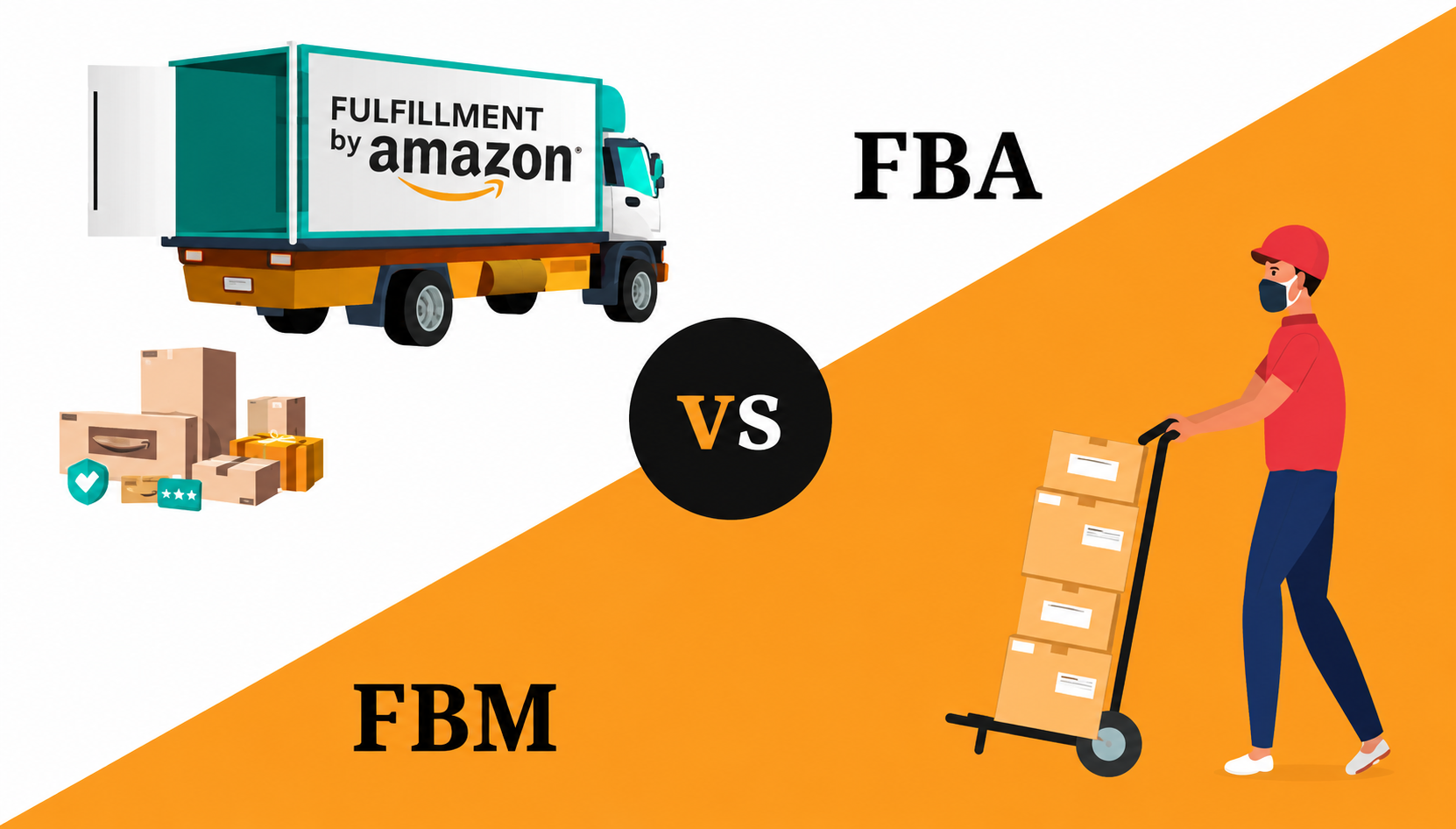
There is no single right answer here, but for sellers building a long-term brand, FBA tends to have a clear advantage.
The biggest one: the Buy Box and the Prime badge.
FBA listings automatically qualify for Prime, meaning customers get fast shipping, typically one to two days in the US. That directly impacts conversion rate, especially in competitive categories. A listing without the Prime badge loses a meaningful share of clicks compared to FBA competitors, even when the product and price are similar.
FBA also lets you scale without scaling your team.
Whether you are shipping 10 units or 10,000 a day, Amazon processes them the same way. That kind of operational leverage is impossible to replicate if you are running your own warehouse.
The tradeoff to understand upfront: cost.
FBA fees include a fulfillment fee calculated by size and weight, plus monthly storage fees based on cubic volume. For bulky or slow-moving products, these costs can significantly compress your margin. This is one of the main reasons product selection matters far more than most new sellers realize. Getting it wrong at the start means optimizing against a structural problem later.
The 4 most common mistakes we see from new sellers
After working with 80+ sellers, these are the patterns we see most consistently from people starting out.
1. Choosing products by instinct rather than data
“I like this product, I think it will sell” is one of the most reliable ways to lose money in FBA. Product research needs to be based on real search volume, real competition levels, actual FBA cost calculations, and realistic margin projections before you place your first order.
We worked with a US-based seller who had already committed to their first inventory order before they came to us. The product sold. But after accounting for all FBA fees, advertising costs, and landed goods cost, the net margin came in under 5%. That is a product research problem, not an operations problem, and it is very hard to fix after the fact.
2. Building a listing and waiting for sales to come
A well-optimized listing is necessary but not sufficient. Amazon is a search engine, and a new listing with no sales history, no reviews, and no advertising support will sit on page 10 while established competitors hold page 1.
The Home & Kitchen brand we helped go from $0 to $567,000+ in year one did not get there by waiting. They launched with a deliberate PPC and launch strategy from day one, and that momentum compounded over time.
3. Assuming a good product will sell itself
Amazon has tens of millions of products. A great product with poor images, weak copy, no reviews, and no advertising will consistently lose to a mediocre product that has been properly optimized. This is a hard truth, but understanding it early saves a lot of wasted spend.
4. Underestimating the full cost structure
Many new sellers calculate product cost against selling price and think they have found a profitable SKU. They forget to include the FBA fulfillment fee, monthly storage fees, referral fee (typically 8–15% depending on category), PPC budget, launch costs, and photography and listing expenses. A product that looks profitable in a spreadsheet can easily lose money in practice if the full cost stack was not modeled correctly from the start.
How to start selling on Amazon FBA: a 6-step process
This is the general framework our team works through when we onboard a new brand.
Step 1: Set up your seller account
You need a Professional Seller account at sellercentral.amazon.com. This costs $39.99 per month on Amazon US, but it is required to access FBA, run advanced ad types, and unlock the full set of Seller Central tools.
The Individual plan ($0.99 per unit sold) does not support FBA and caps you at 40 product listings per month. If you are building a brand seriously, Professional is the only option that makes sense.
You will also need: business entity information, tax details, and an international bank account or payment service for receiving disbursements (Payoneer, Ping Pong, and LianLian are commonly used).
Step 2: Research your product
This is the most important step and the one most commonly rushed or skipped.
A strong FBA product typically meets several criteria: consistent demand that does not depend entirely on seasonal spikes, competition at a manageable level with no dominant national brands owning all the top positions, a margin structure that holds up after accounting for all costs, and dimensions and weight that keep FBA fees reasonable.
At Zonpal, we use Helium 10, Jungle Scout, Data Dive, and Amazon’s own Product Opportunity Explorer to evaluate every opportunity before making a recommendation. See our FBA product research service for more on how we approach this.
Step 3: Source your product
Alibaba, Global Sources, and Made-in-China are the common starting points. But finding a good supplier is not just about finding the lowest price. Consistent product quality, the ability to meet packaging and branding requirements, and reliability over the long term are equally important.
We work alongside clients throughout this process as part of our FBA product sourcing service.
Step 4: Build your brand and listing
A listing on Amazon is not just a product description page. It is a sales asset that combines SEO (so Amazon’s algorithm indexes you for the right keywords), copywriting (to convert browsers into buyers), and imagery and video (to establish trust at first glance).
Three elements that consistently move the needle:
- Product photography: A white-background main image per Amazon’s requirements, lifestyle images, and infographic-style images that communicate key features. A professional image set directly affects CTR and conversion rate.
- A+ Content: This gives you the ability to tell the brand story and present your product in a more visual, compelling format below the fold. It is one of the clearest levers for improving conversion rate for registered brands.
- Keyword research and SEO: Backend search terms, title, and bullet points all need to be optimized for both Amazon’s A10 algorithm and for how real customers actually search and describe what they want.
See: Listing Creation & Optimization, A+ Content EBC Design, Amazon Photography.
Step 5: Launch your product
Launching is the stage most sellers are most apprehensive about, because it is where the most money goes out before anything comes back in. It is also the stage that largely determines the long-term trajectory of the listing.
Amazon’s algorithm favors listings with strong sales velocity, a growing review count, and a good conversion rate. A structured PPC strategy is essential to drive visibility in the early weeks, combined with Amazon Vine if you are eligible, to generate your first verified reviews without violating Amazon’s policies.
The Food & Beverages brand we helped go from $0 to $240,000+ per year did not succeed because they had an exclusive product. They sold in a low-price, high-competition category ($13–$14 price point, 5 SKUs). What made it work was a deliberate launch and PPC strategy that built momentum in the right order.
See: Product Launching & Ranking and Amazon PPC Management.
Step 6: Operate and grow for the long term
After a successful launch, the real work begins. Inventory management, ongoing PPC optimization, review monitoring, Account Health tracking, expanding into new SKUs or markets. This is the phase where many sellers choose to work with an agency rather than manage everything themselves.
A Healthcare account we have managed since May 2023 has reached approximately $1,000,000 in annual revenue with just 3–4 SKUs. That is not the result of one good decision. It is the result of hundreds of small, correct decisions made consistently over time.
See: Full Account Management and Consulting & Strategies.
How much capital do you actually need?
There is no single right number because it depends on the product type, number of SKUs, and your overall strategy. But there is one principle we share with every new seller we work with:
Do not start with capital you cannot afford to lose.
The first year with FBA is a learning year. Mistakes will happen. The question is whether those mistakes are expensive enough to force you out of the game before things start to work.
A realistic cost breakdown for a new seller launching one product:
- Inventory: MOQ of 200–500 units is typical for a standard private label product
- International freight to an Amazon fulfillment center
- Photography and listing creation
- Professional Seller account fee ($39.99/month)
- PPC budget for the launch period (plan for at least 3 months of spend)
Many sellers start with $3,000–$5,000 USD. Others need more, depending on the product and category. The important thing is to map out your full cash flow before committing, not after the inventory order is placed.
Frequently asked questions
Can international sellers use Amazon FBA?
Yes. You do not need a company registered in the US, UK, or Australia to sell in those marketplaces. You need an international payment account, some basic documentation, and a way to ship inventory to the relevant Amazon fulfillment center. Goods can ship directly from your manufacturer to the FBA center without needing to pass through your home country first.
What is the difference between FBA and FBM?
FBA (Fulfillment by Amazon): Amazon stores and ships your inventory. Products carry the Prime badge. Fees are based on size and weight. Better for most standard-size, regularly selling products.
FBM (Fulfillment by Merchant): You store and ship inventory yourself. Lower fees for bulky or slow-moving products, but harder to compete in most categories without Prime eligibility.
Many larger sellers use both in parallel to optimize cost across different parts of their catalog.
Do I need Brand Registry?
It is not required to start, but it is worth doing as early as possible. Brand Registry unlocks A+ Content, the Brand Store, Sponsored Brands ad types, and provides meaningful protection against counterfeit listings and hijacking. It is the foundation for building a sustainable brand presence on Amazon rather than just selling a commodity product.
Where Zonpal can help

Zonpal is an Amazon FBA agency with 8+ years of hands-on experience, working with 80+ sellers and brands across the US, UK, Australia, Canada, and Europe. We provide end-to-end support, from initial setup through to long-term account management:
- FBA Product Research and Product Sourcing
- Listing Creation & Optimization and A+ Content EBC Design
- Product Launching & Ranking and Amazon PPC Management
- Full Account Management and Consulting & Strategies
- Amazon Photography, Amazon Videography, and Amazon Storefront Design
See our case studies for a closer look at how we work and what the results have looked like across different brands and categories.
If you are still figuring out where to start, or you are somewhere in the middle of the journey and not sure what to fix first, the fastest way to get clarity is to talk to someone who has been through it.
Zonpal offers a free Amazon growth audit for sellers and brands who are serious about the process. We look at your current situation across listing, PPC, and account health, tell you exactly where the gaps are, and give you specific next steps, not a generic overview.
Request your free Amazon audit here
Related reading: