If you’re running one giant “catch-all” campaign for each product and watching ACoS creep up every month, the problem usually isn’t your bids. It’s your structure. Most sellers we work with start Amazon PPC advertising with a flat setup: one campaign, a handful of keywords, auto and manual mixed together, and no clear logic for scaling spend.
That setup works fine at $500/month in ad spend. It falls apart at $5,000/month, and it actively bleeds money past $20,000/month. This guide walks through the campaign structure we use to take accounts from launch to scale without the account turning into an unmanageable mess of overlapping keywords and wasted budget.
What you need before you start
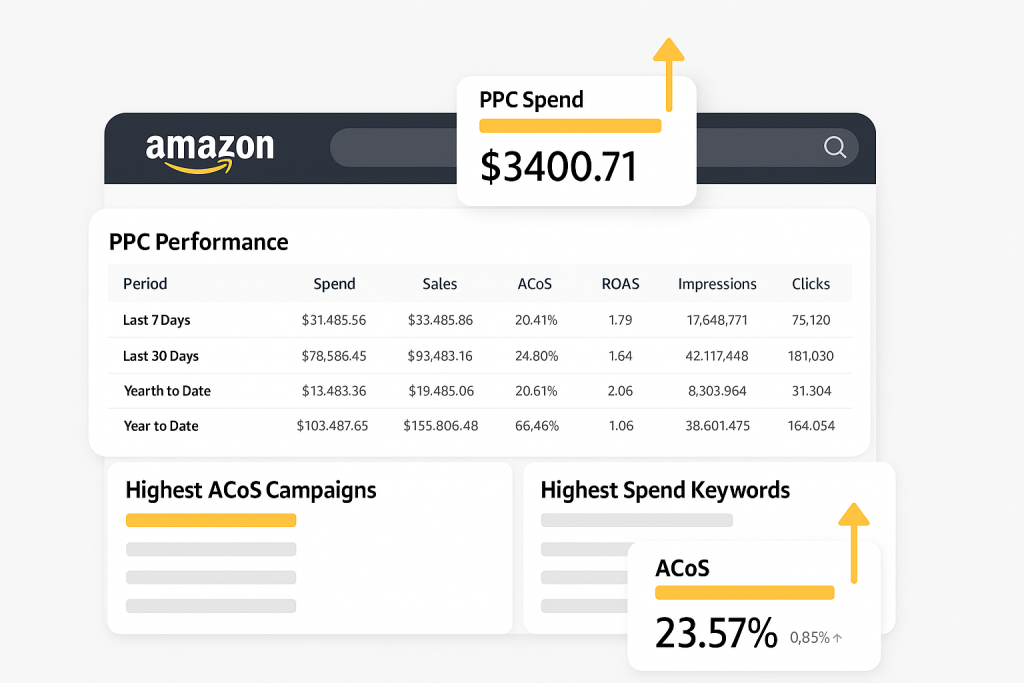
Before restructuring anything, pull your search term report for the last 60-90 days. You need real data, not guesses, to know which keywords are actually converting versus which ones are just burning impressions.
You’ll also need access to Amazon’s Campaign Manager (Seller Central or Vendor Central), a spreadsheet or PPC management tool to track keyword performance by campaign, and a clear view of your current ACoS and TACoS by product. If you don’t know your break-even ACoS for each SKU, calculate it first. Everything in this framework depends on knowing that number.
Finally, set aside time to actually rebuild the structure rather than bolt new campaigns onto the old one. A hybrid of old chaos and new structure is worse than either approach on its own. We’ve seen accounts where sellers added a “clean” exact match campaign on top of three years of unorganized auto campaigns, and the overlap caused keywords to compete against each other and inflate CPCs.
Step 1: Separate campaigns by match type and intent
The foundation of a scalable Amazon PPC advertising structure is separating auto, broad, phrase, and exact match into their own campaigns, never mixed together. Each match type behaves differently and needs its own budget and bid logic.
Auto campaigns are your discovery engine. Let Amazon’s algorithm find search terms you haven’t thought of, then harvest the winners into manual campaigns. Broad and phrase match campaigns are for expansion, catching variations and long-tail terms around your core keywords. Exact match campaigns are where you put your proven, high-converting keywords and push bids hardest.
For a single ASIN, this typically means four campaigns minimum: Auto, Broad, Phrase, and Exact. We’ve managed accounts running 15-20 campaigns per product at scale, but four is the right starting point. Trying to skip straight to a complex structure before you have data to support it just creates noise.
Step 2: Build your keyword harvesting pipeline

Harvesting is the process of mining converting search terms from your auto and broad campaigns and moving them into exact match campaigns with tighter bid control. Without this step, you’re letting Amazon’s algorithm make decisions that should be yours.
Here’s the workflow we use: every 7-14 days, pull the search term report for auto and broad campaigns. Flag any search term with at least 2-3 orders and an ACoS below your target. Add that term as an exact match keyword in your dedicated exact campaign, then negative-match it in the auto and broad campaigns so you’re not paying twice for the same click.
This single habit, done consistently, is the difference between an account that gets more efficient over time and one that plateaus. One account we manage went from a 38% ACoS to under 18% over four months purely from disciplined harvesting and negation, with no bid strategy changes at all.
Step 3: Structure campaigns around funnel stage, not just keywords
Once match type separation is in place, the next layer is thinking about funnel stage: Research, Launch/Conversion, and Scale. This matters more as your catalog grows beyond a handful of SKUs.
Research campaigns target broad, high-volume, top-of-funnel terms to build impression share and gather data, usually run on auto and broad match with modest bids. Launch campaigns target mid-funnel keywords where buyers are comparing options, typically phrase match with moderate-to-aggressive bids to win position. Scale campaigns run on your best-converting exact match terms with your highest bids, since these are the keywords already proven to drive profitable sales.
This structure lets you allocate budget deliberately instead of spreading it evenly across every campaign. If you’re trying to understand how to prioritize spend during a new product launch, our Amazon product launch strategy guide breaks down how PPC fits into the first 90 days specifically.
Step 4: Add defense campaigns for branded and competitor terms
A structure that only chases growth keywords leaves gaps competitors will exploit. Branded defense campaigns, bidding on your own product and brand name, protect your listing from competitors bidding on your traffic. These campaigns are usually cheap to run and convert at a very high rate since the buyer already knows what they want.
Competitor conquesting campaigns, targeting competitor ASINs and brand names, are a different story. These convert at a lower rate and cost more per click, but they’re worth running if your listing, images, and reviews are genuinely stronger than the competitor’s. If your listing isn’t ready to win that comparison, hold off until it is.
We typically recommend allocating 10-15% of total PPC budget to defense and conquesting combined once the core funnel campaigns are stable. Going heavier than that before your core structure is optimized is usually a waste of spend.
Step 5: Set budgets and bids by campaign role, not evenly

One of the most common mistakes we see is splitting daily budget evenly across all campaigns regardless of what each one is supposed to accomplish. Budget should follow performance and funnel role, not an arbitrary even split.
As a starting framework: Scale (exact match, proven keywords) gets the largest share, often 40-50% of total daily budget, since this is where your most profitable sales come from. Launch/conversion campaigns get 25-35%. Research campaigns get 15-20% to keep discovering new terms. Defense and conquesting get the remaining 10-15%.
Bids follow a similar logic. Push bids aggressively on exact match terms with proven conversion data, since you know the math works. Keep broad and auto bids more conservative since you’re paying for discovery, not guaranteed conversion. Review and adjust this split monthly as your search term data shifts; it’s not a set-it-once allocation.
How this structure looks at scale
Once you’re running Amazon PPC advertising across multiple ASINs, this framework multiplies naturally. Each product gets its own Auto, Broad, Phrase, and Exact campaigns, plus shared or product-specific defense campaigns. A brand with 10 SKUs might realistically run 50-70 active campaigns at a mature stage.
The goal isn’t more campaigns for the sake of complexity. It’s enough separation that every dollar of ad spend has a clear job and a clear performance target.
At this stage, manual management becomes genuinely difficult without dedicated tooling or a team watching daily. This is usually the point where sellers either invest in a PPC-focused team member or bring in outside management, since the harvesting, negation, and bid adjustment cadence described above needs daily attention to stay effective at this volume.
Common mistakes (and how to avoid them)
- Mixing match types in one campaign: This makes it impossible to control bids by intent level. Always separate auto, broad, phrase, and exact into their own campaigns.
- Skipping negative keyword hygiene: Without negating harvested terms in their original campaigns, you pay twice for the same converting click. Build negation into your harvesting routine every time.
- Setting budgets evenly across campaigns: This starves your best-performing exact match campaigns of budget while overfunding low-converting discovery campaigns.
- Launching conquesting campaigns too early: If your listing can’t win the comparison once a shopper lands on it, you’re just funding brand awareness for the competitor’s product page.
- Never reviewing the structure after building it: Search term trends shift seasonally. A structure that worked in Q1 often needs rebalancing by Q3.
Wrapping up
A campaign structure built around match type separation, funnel stage, and disciplined harvesting will consistently outperform a flat, catch-all setup, regardless of how much you spend on PPC each month. The framework above is the starting point we use with nearly every account before we layer on more advanced tactics like dayparting or dynamic bid rules.
If your current structure is a tangle of overlapping campaigns and you don’t have the bandwidth to rebuild it while running the rest of your business, our team handles this restructuring and ongoing management directly. You can see how we approach it on our Amazon PPC management page, and we’re happy to review your current campaign setup and tell you honestly where the biggest leaks are.