Amazon Brand Protection: Secure Your Listings and FBA Profit
Are you tired of waking up to find a “hijacker” has stolen your Buy Box and slashed your prices overnight? As an Amazon seller, you don’t just compete with products; you compete with bad actors looking to ride on your success. Implementing a robust brand protection Amazon strategy is the only way to ensure your hard-earned rankings and margins don’t vanish into the hands of counterfeiters.
In this guide, we’ll explore how to build a bulletproof defence for your business using official tools and expert management tactics.
What is Amazon Brand Protection?
To defend your business, you must first understand the battlefield. Amazon brand protection is more than just a setting in your Seller Central; it is a comprehensive shield for your intellectual property.
Defining Brand Protection Amazon
At its core, brand protection Amazon refers to the strategic use of Amazon’s internal tools, legal frameworks, and operational tactics to prevent unauthorized parties from exploiting your brand equity. This includes protecting your trademark, your copyrights, and your physical inventory. It is the practice of ensuring that when a customer clicks “Add to Cart,” they receive exactly what they expect: an authentic, high-quality product from you, the brand owner.
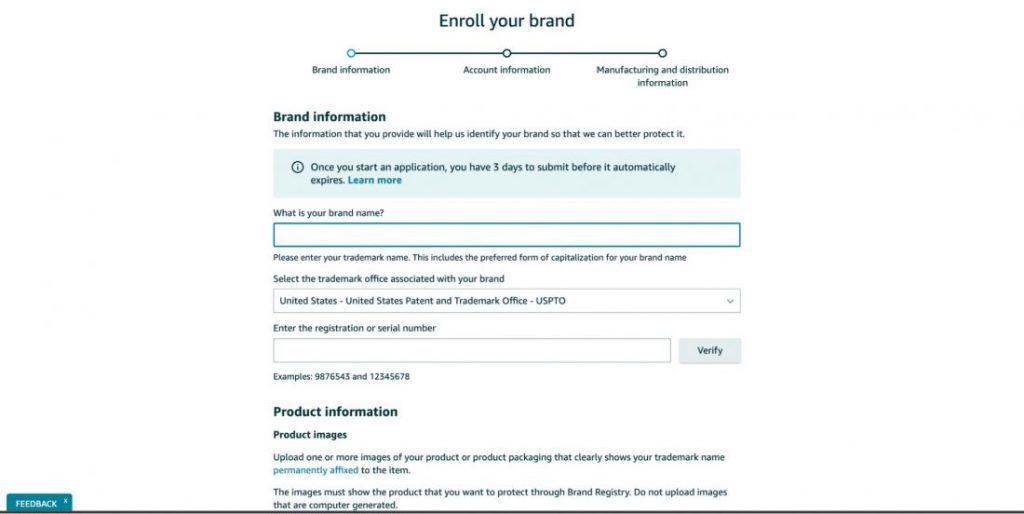
What’s Amazon Brand Protection?
Why Proactive Defense is Mandatory
The “Wait and See” approach is the most expensive mistake you can make. Amazon’s platform is designed for speed and customer choice, which unfortunately makes it “friendly” to third-party sellers until you prove they shouldn’t be there. If you wait until a hijacker arrives to apply for a trademark or Brand Registry, you are already three months too late. Proactive defense means setting up the barriers before the intruders arrive, allowing Amazon’s automated AI to do the “policing” for you.
Impact of Brand Erosion on FBA Margins
Brand erosion is a slow death. When a counterfeit seller offers a cheap knock-off on your listing, the customer gets a bad product and leaves a 1-star review. Amazon’s algorithm sees the drop in conversion and the increase in returns, and it begins to de-rank your listing. Within weeks, your organic ranking drops from page 1 to page 10. Reclaiming that spot costs thousands in PPC and promotional spend. In short: failing to protect your brand is a direct tax on your net profit.
10 Strategic Ways to Protect Your Brand
A fortress isn’t built with one wall; it requires a layered defense system. Below are 10 battle-tested strategies that every elite FBA brand uses to maintain a 100% Buy Box share.
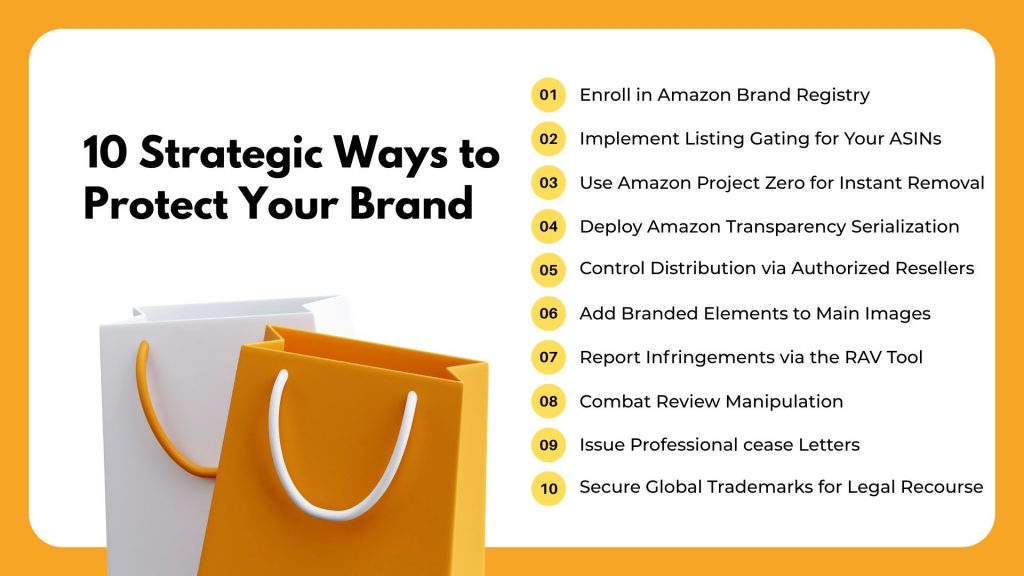
10 Strategic Ways to Protect Your Brand
1. Enroll in Amazon Brand Registry
This is the absolute baseline. Without Brand Registry, you are a “ghost” on the platform. Registry unlocks the Amazon listing brand protection suite, giving you increased authority over your product detail pages. It allows you to lock your images, titles, and descriptions so that unauthorized sellers cannot change your branding to suit their generic fakes.
2. Implement Listing Gating for Your ASINs
“Gating” is the ultimate deterrent. While not available to every brand immediately, successful enrollment in Brand Registry and a history of reporting infringements can lead to Amazon “gating” your brand. This means any new seller who wants to list your product must submit invoices from your authorized supply chain and pay a non-refundable fee (often $1,000+). Most hijackers will see a gated brand and immediately move on to an easier target.
3. Use Amazon Project Zero for Instant Removal
Traditionally, you had to file a report and wait for an Amazon investigator to approve it. Amazon Project Zero changes the game by giving you “Self-Service” counterfeit removal. If you see a fake, you can delete it instantly. This tool uses Amazon’s machine learning to constantly scan stores and remove listings that match your protected IP.
4. Deploy Amazon Transparency Serialization
Transparency is a serialization service that acts as a physical “passport” for every unit. You apply a unique 2D barcode to every box. When that unit reaches an Amazon fulfillment center, the worker scans the code. If the code is missing or incorrect, the unit is flagged as counterfeit and never reaches the customer. This stops fakes before they are even checked into inventory.
5. Control Distribution via Authorized Resellers
One of the biggest leaks in brand protection Amazon is your own supply chain. If you sell to wholesalers who then flip your stock to unauthorized third parties, you lose control. Implementing a strict “Authorized Reseller Agreement” allows you to track where your inventory goes legally and gives you the grounds to issue “Test Buys” to prove a seller is not part of your network.
6. Add Branded Elements to Main Images
While Amazon has strict rules about white backgrounds, you can still be clever. Including your unique, branded packaging in the main image (as long as the product is the focus) signals to customers—and hijackers—that this is a private label brand. Hijackers hate branded packaging because they can’t replicate it easily, making their “generic” version obvious to customers.
7. Report Infringements via the RAV Tool
The “Report a Violation” (RAV) tool is your surgical weapon. It allows you to search the entire Amazon catalog for your images or trademarked terms being used by others. An expert brand protection Amazon management strategy involves checking this tool weekly to prune away copycats before they grow.
8. Combat Review Manipulation and Fake Feedback
Bad actors often use “Review Bombing” (buying dozens of fake 1-star reviews) to tank a competitor’s ranking. While difficult to fight, you can protect yourself by maintaining a high volume of legitimate reviews through the Amazon Vine program and by reporting suspicious spikes in negative feedback to the community integrity team immediately.
9. Issue Professional cease Letters
Before you go to war with Amazon’s legal team, a well-drafted “Cease and Desist” (C&D) letter sent through the Amazon messaging system can resolve 70% of issues. When a hijacker sees a letter from an Amazon brand protection agency or a law firm, they usually realize the risk of their account being banned isn’t worth the small profit from your listing.
10. Secure Global Trademarks for Legal Recourse
Many sellers only register a trademark in the US. However, hijackers often operate out of China or Europe. Securing your trademark in the regions where you manufacture and where you sell gives you global standing. This is essential for participating in the Amazon Counterfeit Crimes Unit (CCU) investigations.
Common Amazon Brand Threats to Avoid
Understanding the “Why” is just as important as the “How.” Let’s examine the specific threats that a robust Amazon brand protection solution is designed to prevent.
Listing Hijacking and Buy Box Theft
This is the most common “Day 1” threat. A hijacker finds your high-ranking ASIN and lists their version of the product under your listing. Because they didn’t spend money on marketing or photography, they can underprice you, taking the Buy Box. Customers think they are buying your product, but they receive a cheap substitute.
Counterfeit Products and Brand Dilution
Counterfeits don’t just steal a sale; they steal your reputation. If a fake product breaks or causes an injury, the customer doesn’t blame the hijacker—they blame your brand name. This leads to a permanent stain on your brand’s “Review Moat” that can take years to clean up.
IP Theft and Trademark Squatting
“Trademark Squatters” are professional bad actors who monitor the US Patent and Trademark Office (USPTO). If they see a brand growing on Amazon that hasn’t registered their name in China or the UK, they will register it themselves and then try to “ransom” the trademark back to the original owner for thousands of dollars.
The “Grey Market” Challenge: MAP & Distribution
While hijackers are the visible enemy, the silent killer of successful FBA brands is often the “Grey Market.” This refers to genuine products sold through unauthorized channels.
Stopping Unauthorized Resellers vs. Counterfeiters
If a seller buys your product at a 50% discount from a retail liquidator and resells it on Amazon, they aren’t selling a “fake,” but they are still damaging your brand. They don’t follow your customer service standards and they don’t care about your long-term success. A professional Amazon brand protection agency can help you differentiate between these two and apply the correct enforcement strategy.
Stopping Unauthorized Resellers vs. Counterfeiters
Enforcing MAP Policies to Protect Brand Value
A Minimum Advertised Price (MAP) policy is your primary tool for price stability. If you have multiple authorized resellers, they must all agree not to sell below a certain price (e.g., $29.99). While Amazon will not enforce MAP for you, having this policy allows you to legally terminate your relationship with any wholesaler who “tanks” the price and triggers a downward spiral of devaluations.
Legal Tactics for Off-Amazon Inventory Leaks
Expert Amazon brand protection management involves “Test Buys” and “Lot Code Tracking.” By purchasing a unit from an unauthorized seller, you can check the internal lot code to see exactly which wholesaler you sold that unit to. This allows you to cut off the “leak” at the source, effectively starving the unauthorized seller of inventory.
Why Professional Defense Maximizes Profit
Ultimately, brand protection is a profit-maximizing strategy. When your brand is a “fortress,” your business runs more efficiently.
- Protecting Your Buy Box Share: You get 100% of the sales you worked for. No “parasite” sellers taking a cut of your traffic.
- Preserving Long-Term Customer Trust: Your reviews stay clean, your return rate stays low, and your “Lifetime Customer Value” increases.
- Streamlining Enforcement with Expert Help: Instead of panicking when a threat appears, you have a standardized protocol to eliminate it in hours, not weeks.
>>> See more: Stop Selling Products, Start Building Brands: Your Strategic Guide to Amazon Dominance <<<
Conclusion
In the world of Amazon FBA, “Hope is not a strategy.” You cannot simply hope that hijackers won’t find you. If you are successful, they will find you. The only question is: what will they find when they get there? Will they find an open, unprotected listing, or will they find a brand-registered, transparency-coded, and professionally managed fortress?
Building an iconic brand on Amazon is a journey of thousands of hours. Don’t let a single bad actor take it away from you on a weekend. Protecting your legacy requires both vigilance and expertise. If you’re feeling overwhelmed by the technicalities of Brand Registry, the complexities of Project Zero, or the constant threat of hijackers—or if you simply aren’t sure where to start—you don’t have to face it alone. You can contact Zonpal for expert advice and comprehensive support. Our team specializes in defending high-growth FBA brands, allowing you to stop playing defense and start focusing on your next big launch.