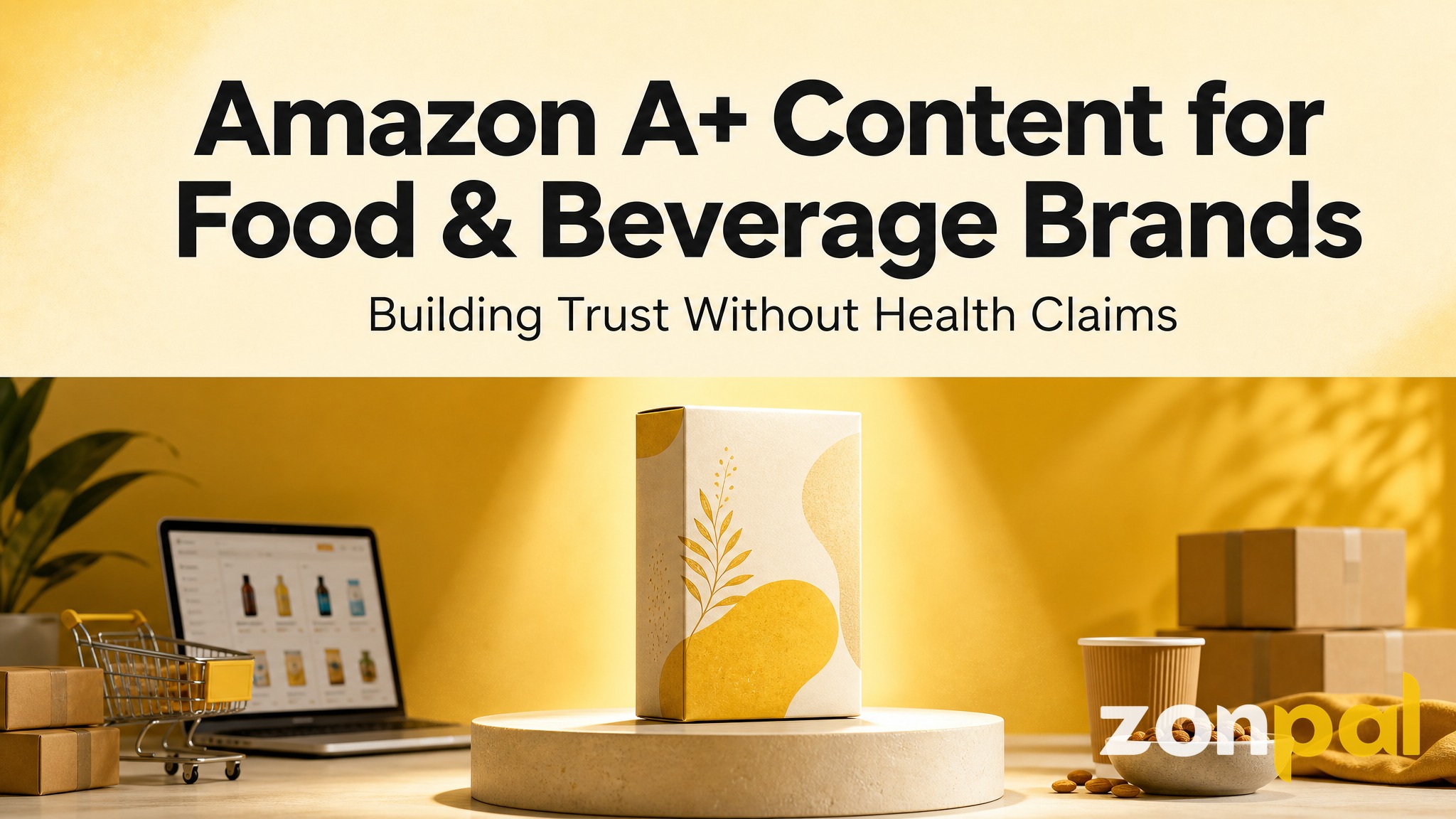
Food and beverage brands run into a wall that most other categories don’t: you can’t talk about your product the way you actually want to. Say “boosts immunity” or “reduces inflammation” and you’re one flagged listing away from a suppression notice. Amazon and the FDA both watch this category closely, which means a huge chunk of the persuasive language other sellers rely on is simply off the table for you.
That doesn’t mean your A+ Content has to be flat or generic. It means you need a different playbook, one built on transparency, proof, and sensory detail instead of claims. This guide walks through exactly how to build A+ Content for a food or beverage brand that converts without triggering a compliance review.
What you need before you start

Before you open the A+ Content builder, get three things in order. First, pull your current label and any third-party lab reports, certifications, or sourcing documentation. You’ll reference these constantly, and having them on hand saves you from writing vague copy because you “think” your product is non-GMO or allergen-free.
Second, read Amazon’s restricted claims policy for your subcategory. Supplements, snacks, beverages, and specialty foods each have slightly different sensitivities. A protein bar brand can talk about grams of protein per serving because that’s a fact on the label. A tea brand cannot say it “reduces stress” because that’s a health claim, even if customer reviews say exactly that.
Third, decide who owns compliance review internally. On most food and beverage accounts we’ve worked on, the biggest source of content rework isn’t creative disagreement, it’s catching a risky phrase after the module is already live. Assign one person to sign off on final copy before publishing, every time.
Step 1: Know exactly what you can’t say
Amazon draws a hard line around disease claims, structure/function claims that imply medical benefit, and anything that could be read as a promise about health outcomes. “Supports digestion” is generally fine if your product has fiber or probiotics to back it up. “Cures bloating” is not. “Made with real fruit” is fine. “Prevents inflammation” is not, even for a turmeric shot.
The safest mental model: describe what’s in the product and how it’s made, not what it will do to the customer’s body. This single shift changes how you write every headline in your A+ modules.
We’ve seen accounts get an entire A+ module rejected over one line: “helps balance gut health.” Swapping it to “made with 5 billion CFU live cultures per serving” kept the same idea, backed it with a fact, and passed review immediately.
Keep a running list of banned words for your specific niche: cure, treat, prevent, heal, boost immunity, anti-inflammatory, detox. When in doubt, replace the claim with a specification, a process detail, or a sourcing fact.
Step 2: Audit your current A+ content line by line

If you already have A+ Content live, don’t rebuild from scratch. Audit it first. Go module by module and flag any sentence that makes an implicit health promise, even a soft one like “energizing” or “gut-friendly” without data behind it.
Run this audit with three questions per line of copy:
- Is this a fact I can prove with a label, certificate, or lab result?
- Does this imply a health outcome, even indirectly?
- Would a compliance reviewer at Amazon flag this if they read it cold?
For one snack brand we reviewed, the audit turned up seven separate soft claims spread across four modules, phrases like “clean energy” and “gut-loving ingredients” that had been sitting live for over a year without issue, purely by luck. Rewriting them into ingredient-based statements (“15g of prebiotic fiber per bar”) kept the same selling point and removed the risk entirely.
Do this audit quarterly, not just at launch. Amazon’s enforcement tightens periodically, and copy that passed review two years ago isn’t guaranteed to pass today.
Step 3: Build trust through ingredient transparency and sourcing
Food and beverage shoppers are unusually skeptical buyers. They read ingredient panels. They Google unfamiliar additives. If your A+ Content doesn’t address where things come from and why, you’re leaving that skepticism unresolved right at the point of purchase.
This is where a sourcing story module earns its place. Show where the coffee beans are grown, how the honey is harvested, or why you chose cane sugar over corn syrup. This isn’t a health claim, it’s a factual, verifiable story that builds credibility without touching regulated language.
One useful format is a “farm to shelf” or “how it’s made” comparison module: a simple visual timeline from raw ingredient to finished product. It reads as craftsmanship and quality control, not medical benefit, and it consistently performs well in category benchmarking because it answers the “is this actually good quality” question directly.
If your brand sources anything specialty (single-origin cacao, wildflower honey, a specific region’s olive oil), lead with that. Specificity reads as authenticity. Vague language like “premium ingredients” reads as filler and shoppers scroll past it.
Step 4: Lean on certifications and third-party proof instead of claims
Certifications do the persuasive work that claims can’t. USDA Organic, Non-GMO Project Verified, Certified Gluten-Free, Fair Trade, Kosher, third-party lab testing seals: these are all facts, not claims, and Amazon treats them accordingly. A comparison chart module built around certifications is one of the highest-converting formats we see in this category because it lets the shopper draw their own health conclusions from verified facts.
Build a dedicated “why choose us” or comparison chart that lists your certifications against generic competitors or private label alternatives. Use checkmarks, not paragraphs. Shoppers scan these modules in seconds, and a clean visual comparison does more work than three sentences of copy ever will.
If you have third-party lab testing (common for supplements, protein powders, and specialty beverages), display the batch testing process visually. “Every batch tested for heavy metals and purity by an independent lab” is a statement of fact about your quality control process, not a claim about health outcomes, and it directly answers the trust question that health claims used to answer.
Step 5: Show real usage occasions and honest comparisons
Since you can’t tell shoppers what the product will do for their body, show them what it does in their day. A cold brew concentrate module showing “iced, blended, or mixed into smoothies” sells the product through use case, not promise. A protein bar shown pre-workout, mid-hike, and in a lunchbox tells a story about fit-into-your-life without ever claiming a physical outcome.
Comparison modules work well here too, as long as they compare specifications rather than outcomes. “12g protein vs. 8g protein” is a fact-based comparison. “Better for your energy than the leading brand” is a claim you likely can’t support. Keep every comparison anchored to something printed on a nutrition panel or verified by a lab.
We’ve also seen strong results from modules that address a specific objection directly, like taste or texture concerns for functional beverages. “Doesn’t taste like medicine” or “smooth, not chalky” addresses the real hesitation a shopper has without ever touching a health claim.
Step 6: Structure your A+ modules specifically for food and beverage
Generic A+ templates don’t map well onto this category. Instead of a standard lifestyle-plus-features layout, build your module sequence around the questions a food or beverage shopper actually has, in this order:
- What is this, exactly? Hero module with product, format, and flavor lineup.
- What’s in it? Ingredient transparency module with sourcing detail.
- Is it legitimate? Certification and third-party testing comparison chart.
- How do I use it? Usage occasion module with real-life context.
- How does it compare? Spec-based comparison chart, not outcome-based.
- Who makes it? Brand story module, ideally with a founder or small team framing that reinforces care in sourcing and production.
This sequence mirrors how skeptical food shoppers actually evaluate a product, moving from “what is it” to “can I trust it” to “does it fit my life.” If you’re building this out for the first time, our breakdown on writing A+ Content brand story modules covers how to structure the founder and sourcing sections in more depth.
Common mistakes (and how to avoid them)
These are the errors we see most often when food and beverage brands build out A+ Content:
- Copy-pasting supplement fact language into other subcategories. Rules differ between supplements, conventional foods, and beverages. What’s allowed for a protein powder isn’t automatically allowed for a snack bar.
- Relying on adjectives instead of specifications. “Powerful,” “clean,” and “pure” carry no regulatory weight and don’t build trust the way a certification badge or a gram count does.
- Skipping the compliance re-check after a formula change. If you reformulate to remove an allergen or reduce sugar, your existing A+ claims may no longer be accurate, which is its own compliance risk.
- Treating certifications as decoration instead of proof. Certification logos work best inside a comparison module with context, not scattered as small icons with no explanation.
- Ignoring seasonal or regional sourcing changes. If your honey source or coffee origin shifts, update the sourcing module. Outdated sourcing claims are one of the more common triggers for listing flags in this category.
Wrapping up
Food and beverage A+ Content lives inside a narrower lane than most categories, but that constraint isn’t a weakness if you build around it correctly. Facts, certifications, sourcing detail, and real usage context do the trust-building work that health claims used to do, and they hold up under Amazon’s review process instead of risking a suppression.
If you’d rather have a team that already knows the compliance boundaries in this category build and audit your A+ modules, our listing creation and optimization service handles exactly this kind of work for food and beverage brands, from claims review to full module design.